
5 tips for correct treadmill use
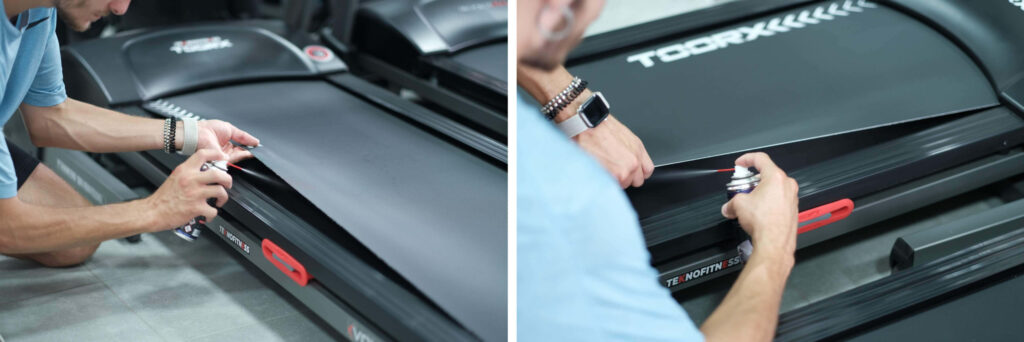
1) Lubrication
To ensure proper product functioning, we recommend regular lubrication approximately every 8-10 hours of use, by slightly lifting first one and then the other end of the belt to apply silicone lubricant under the belt in the central area of the deck. The lubricant must be silicone-based; do not use Svitol or WD40 as they are very aggressive on the belt's rubber. We recommend every 2-3 months of use to lift the belt, thoroughly clean the wooden board of lubricant residue, rubber, or dust, and then proceed with lubrication again.
- Lift the edge of the belt from one side and, using the straw, insert the lubricating oil as far as possible towards the center of the board.
- Repeat the operation on the other side.
- Start the treadmill at a low speed and let it run for a few minutes.
- Check that the lubricant is spread over the entire surface.
ATTENTION:
1) New treadmills are not lubricated; lubricate before first use.
2) It is not necessary to loosen the belt for lubrication.

For proper power supply to the treadmill, we recommend plugging the cord directly into the electrical outlet, without using adapters or power strips, especially inexpensive ones. If strictly necessary, we advise using high-quality extension cords or power strips. If the current is not constant, the treadmill's control board can experience voltage drops, leading to the machine stopping and an error message on the display.

3) Belt Calibration
Belt calibration may involve two interventions, to be performed if necessary:
– The first intervention is aimed at adjusting the BELT TENSION:
It can sometimes happen that during treadmill use, a jerking sensation is felt when the foot lands, a relatively common problem but easy to solve: by using an Allen key, it is possible to adjust the screws at the back of the treadmill, which control the position of the rear roller. With the motor off, tighten BOTH SCREWS clockwise, starting with a HALF TURN rotation. Then check its tension by pressing the belt under the deck, and after a test walk, repeat the operation if necessary.
– The second intervention is aimed at CENTERING THE BELT: It sometimes happens that, due to uneven flooring or uneven foot pressure during walking, the belt shifts to one side of the deck. Shifts of a few millimeters are perfectly normal and do not require intervention, but neglecting the problem if the belt continues to shift can lead to issues. In this case, the intervention should be performed with the MOTOR ON, setting a speed of 3-4 Km/h. With an Allen key, adjust the rear screw ON THE SIDE WHERE THE BELT IS CLOSER TO THE EDGE and, by turning the screw clockwise ONE QUARTER TURN AT A TIME, you can adjust the belt's position, which will change after a few rotations (it can take up to 30 seconds to see the movement). Repeat the operation if necessary and, once centered, leave the screw in the correct position.

4) External and Internal Cleaning
From time to time, it may be necessary to clean your treadmill. For external parts (frame, console, and belt), we recommend a soft cloth dampened with water (we advise against using solvents that can damage plastics). For more thorough maintenance, it may be necessary to clean under the motor cover (recommended at least once a year). In this case, proceed to remove the screws that secure it to the frame and, with a vacuum cleaner, you can remove dust and debris that have accumulated between the components, always being careful not to hit them. Then reassemble the cover in position and secure it to the frame with the original screws.
5) Preserving the Motor
For direct current (DC) motors, such as those installed in most home-use treadmills, in case of prolonged use sessions (if multiple people need to train, for example), we recommend allowing the motor to cool down between training sessions. This ensures proper motor cooling and extends its lifespan. Note that direct current (DC) motors are suitable for training durations as follows:
- 1.5 – 2 HP DC motors: up to 40-60 minutes of training
- 2.5 to 3 HP DC motors: up to 60-90 minutes of training
- Higher HP motors: up to 2 hours of training
These values are theoretical and also clearly vary based on the user's weight and speed.
Alternating current (AC) motors can run for much longer periods due to their power and technology.