
Treadmill: Buying Guide
In this guide, we'll discover which treadmill model to choose based on your needs. The treadmill is certainly the most well-known and common fitness equipment; it has entered common parlance with its French name "tapis roulant" (literally "rolling carpet" in English, but referred to as "treadmill").
HISTORY
The patent for the first training treadmill was filed by Claude Laurain Lagen of New York in 1917 and was simply called a "training machine." It consisted of a rectangular base and rollers covered with non-slip tape. In 1968, Pennsylvania engineer William Staub built the first marketable model, convinced by the new theory that just 8 minutes of running a day was enough to improve one's health.
ADVANTAGES
The treadmill is a perfect piece of equipment for aerobic use, allowing for regular walking or running and stimulating cardiorespiratory functions. It's an excellent solution for those who want to optimize their available time, enabling walking or running at different speeds and inclines. It is also very useful for elderly people who do not risk falling because they can hold onto the two side handrails or the central one.
- It is a very easy-to-use piece of equipment to supplement or replace outdoor training
- It accurately reproduces the motion of walking or running
- It allows for immediate control of all values: heart rate, calories, speed, time, and distance
- It allows for maintaining a consistently regular pace for better aerobic work
- Almost all treadmills have a wide variety of training programs
- The treadmill is equipped with a cushioned deck that eliminates impact trauma to the limbs from asphalt
Considering only electric treadmills (magnetic ones do not offer good performance), the main features for choosing a good machine are:
MOTOR: can be AC or DC (alternating current or direct current). Direct current is for domestic use only. Alternating current is for gym use or particularly intense workouts and requires a higher current draw. Motor power is expressed in horsepower and typically ranges from 1.5 hp to 3.5 hp and above.
A more powerful motor ensures less overheating, thus greater durability over time, as well as more immediate and precise power and speed delivery.
SHOCK ABSORBERS: very important, they allow perfect use of the equipment without affecting the joints. Damping is determined by elastomers placed under the treadmill deck, which absorb the user's weight and vary in shape and thickness depending on the quality of the equipment.
BELT THICKNESS: ranges from 1.2 mm to a maximum of 4 mm for professional treadmills.
USER WEIGHT: you should always consider the weight of the user; generally, the capacity ranges from 100 kg to 180 kg. It is clear that the higher the weight capacity, the more reliable the treadmill, as more powerful motors and shock absorbers are used.
SPEED: the minimum speed starts from 1 km/h up to a maximum that can vary from 12 km/h to 24 km/h depending on the motor's power.
INCLINE: The treadmill can have manual incline (via special interlocking adjusters) or electric incline (via a second motor controllable via the console). Manual incline is used in lower-priced treadmills and has the sole advantage of lower cost, but it is inconvenient to manually vary the incline, which can only be chosen at the beginning of the workout. Any programs will therefore only be speed-time-distance. Electric incline, on the other hand, allows you to change it during the workout with buttons on the console or handrail without having to interrupt the exercise. Furthermore, the programs will include speed-time-distance-incline.
CATEGORIES
All treadmills are divided into folding, space-saving, and fixed:
FOLDING: All treadmills have the ability to raise the running deck and reduce their footprint to approximately 1 square meter when not in use. The closing or opening of the running deck is operated by hydraulic pistons, which significantly reduce the effort of the closing action and gently guide the belt to the floor when opening.
SPACE-SAVING: These have minimal dimensions, ranging from 18 cm to 35 cm in thickness, and are very easy to store in very confined spaces (under the bed or behind furniture). The only disadvantage of treadmills in this category is that they generally have a smaller motor and a less effective cushioning system.
FIXED: This category includes only professional gym treadmills which, to withstand very intense work rhythms for several hours a day, have a very resistant structure with welded joints, making them non-foldable.
CONSOLE
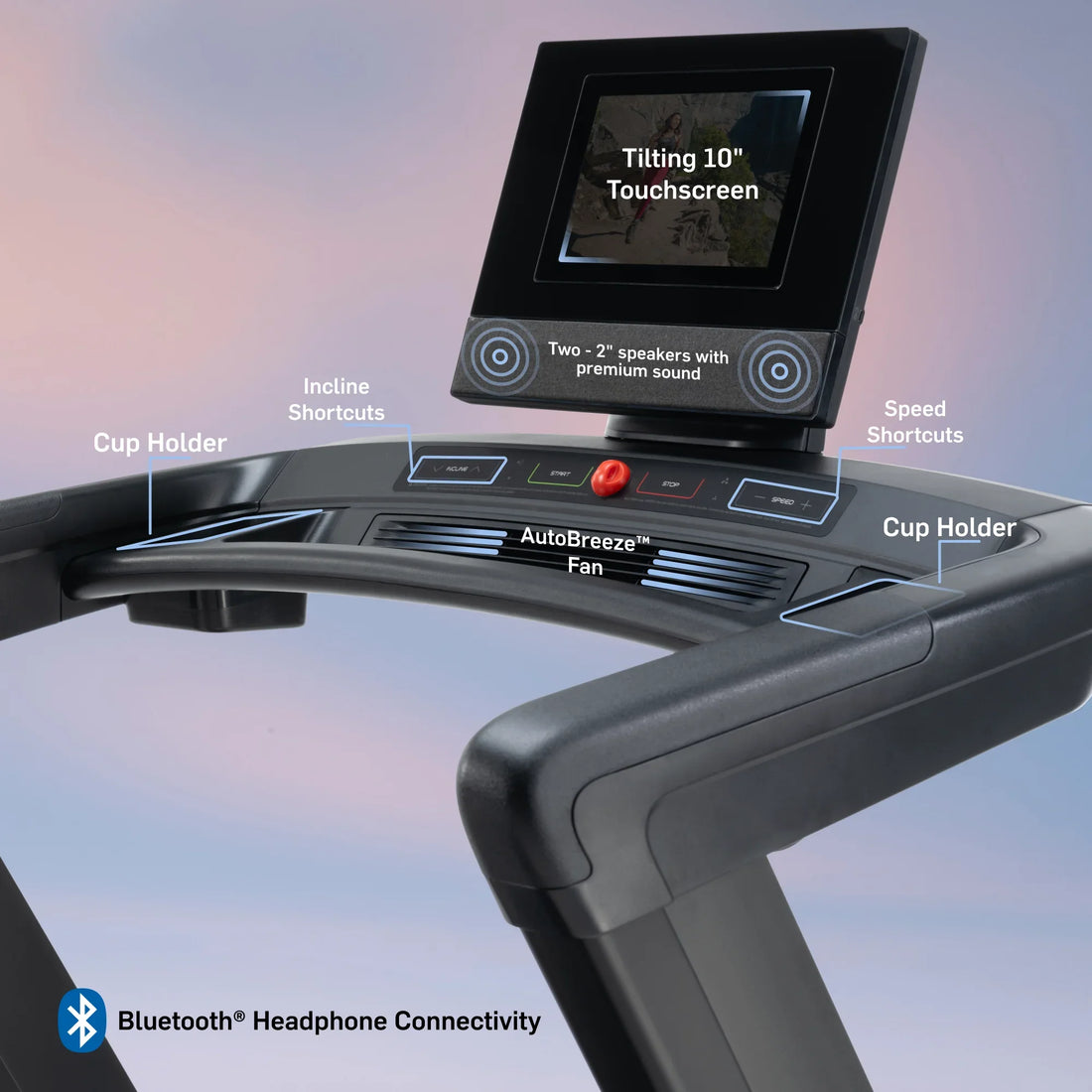
Depending on the model, the console can provide information on speed in km/h, time, distance, calories, and heart rate detected via hand pulse or chest strap. All electric treadmills offer the option to choose from several pre-set programs: in this case, the treadmill will automatically vary both speed and incline (in models with electric incline) at predefined intervals. The programs are suitable for both beginner runners and more experienced ones.
ASSEMBLY AND MAINTENANCE
Some treadmill models come pre-assembled, and in all other models, assembly is very simple. It consists of attaching only the two side uprights and the console with the appropriate screws and connecting the electrical cables with simple interlocking plugs. All information is available in the instruction manual, strictly in Italian. Our store also offers the possibility of receiving the treadmill at home, already assembled and ready to use, and we deliver to your floor.
Maintenance is very simple and consists of periodically lubricating the belt (every 15 days) by lifting it from the side and checking the belt's centering (by adjusting the two hex screws at the end of the running deck) as specified in all attached instructions. Regarding lubricant, we strongly recommend using a silicone-based solution specifically designed for treadmill rubber.
ELECTRIC CONSUMPTION
The electrical consumption of a treadmill is often.
First of all, it should be clarified that treadmill consumption does not depend on the motor's power but on various factors such as the user's weight, the quality - size - lubrication and tensioning of the running belt, as well as the training speed.
The incline of the treadmill also affects consumption: when going uphill, the belt will also move due to gravity, thus the motor will strain and consume less.
Based on our wattmeter measurements, we have compiled the following table which provides indicative values for a treadmill in good condition:
| SPEED | |||||
| USER WEIGHT | 6 km/h | 9 km/h | 12 km/h | 15 km/h | |
| 60 kg | 271watt | 451watt | 587watt | 722watt | |
| 70 kg | 285watt | 475watt | 618watt | 760watt | |
| 80 kg | 300watt | 500watt | 650watt | 800watt | |
| 90 kg | 285watt | 475watt | 618watt | 760watt | |
| 100 kg | 331watt | 551watt | 717watt | 882watt |