
Rubber mats for the gym: a practical guide for home gyms and fitness centers

For a home gym, EVA puzzle mats with an appropriate thickness for basic use are the right choice; for professional weightlifting or areas with dropped weights, SBR/EPDM recycled rubber tiles with greater thicknesses are the most reliable solution. The difference is not just in material: it's in density, load resistance, and durability. Choosing the wrong flooring means ending up with deformed surfaces, open seams, and insufficient subfloor protection.
Three scenarios, three quick answers:
- Home gym without equipment (cardio, yoga, bodyweight): 10–20 mm EVA puzzle mats, 60x60 cm format, easy to lay and remove without tools. See recommended models on Teknofitness.
- Weightlifting area with barbells and heavy dumbbells: 8 to 20 mm SBR/EPDM rubber tiles, high density, certified resistance to repeated loads.
- Cardio area with treadmill or exercise bike: 6 mm soundproofing mat under each machine, plus a layer of EVA or rubber tiles for the rest of the area.
All materials must comply with the REACH regulation, be free of phthalates and BPA, and have a technical data sheet available. Teknofitness offers personalized advice, installation, and direct assistance to help you choose the right solution for your space.
Key points
The choice of rubber gym flooring depends primarily on thickness and density, not the price per square meter,
| Point | Details |
|---|---|
| Thickness based on use | progressively greater thicknesses are recommended for cardio and bodyweight, moderate weights, and intense weightlifting, respectively. |
| Right material for each area | EVA for light home gyms; SBR/EPDM for areas with repeated loads and dropped weights. |
| Certifications to request | REACH compliance, absence of phthalates and BPA, durometer data (Shore A), and complete technical data sheet. |
| Calculate m² and format | Measure the area, divide by the surface of the chosen tile, and add 10% for waste. |
| Consultation | With various models in our catalog, contact us to find the right solution for your fitness space. |
Table of Contents
- What are the types of rubber gym mats and how do they differ?
- How to choose the right flooring: technical criteria and warning signs
- Formats and dimensions: how many tiles do you need and how to calculate square meters
- How to install and maintain rubber gym mats?
- Materials, safety, and certifications: what to check before buying
- Teknofitness solutions and services: catalog, installation, and assistance
- Request a quote from Teknofitness: what to prepare and how to proceed
- Sources
What are the types of rubber gym mats and how do they differ?
The market offers three main categories, each with distinct structural characteristics. Understanding the differences allows you to avoid purchases that seem convenient but turn out to be inadequate after a few weeks of intense use.
EVA puzzle mats
EVA (ethylene-vinyl-acetate) is a lightweight foam, soft to the touch, and easy to work with. EVA puzzle mats interlock without glue, can be cut with a utility knife, and removed in minutes. They are the ideal solution for a home gym: they offer good shock absorption, basic sound insulation, and low costs. The limitation is density: under repeated and heavy loads, the foam compresses and loses shape over time. For bodyweight exercises, yoga, or light cardio, a thickness of 10–15 mm is sufficient; for workouts with moderate weights, it's better to opt for denser flooring.
Recycled rubber tiles (SBR/EPDM)
Recycled SBR (styrene-butadiene rubber) is the benchmark material for professional gyms. Dense, wear-resistant, and capable of absorbing repeated impacts without deforming, it can handle Olympic barbells and heavy equipment without issues. Rubber tiles are available in various thicknesses and are suitable for CrossFit boxes, weight rooms, and functional areas. EPDM (ethylene-propylene-diene-monomer) is often used for the surface layer, adding weather resistance and a more pronounced non-slip finish. The weight of these tiles is greater than EVA, but their durability is significantly superior.
Rubber rolls
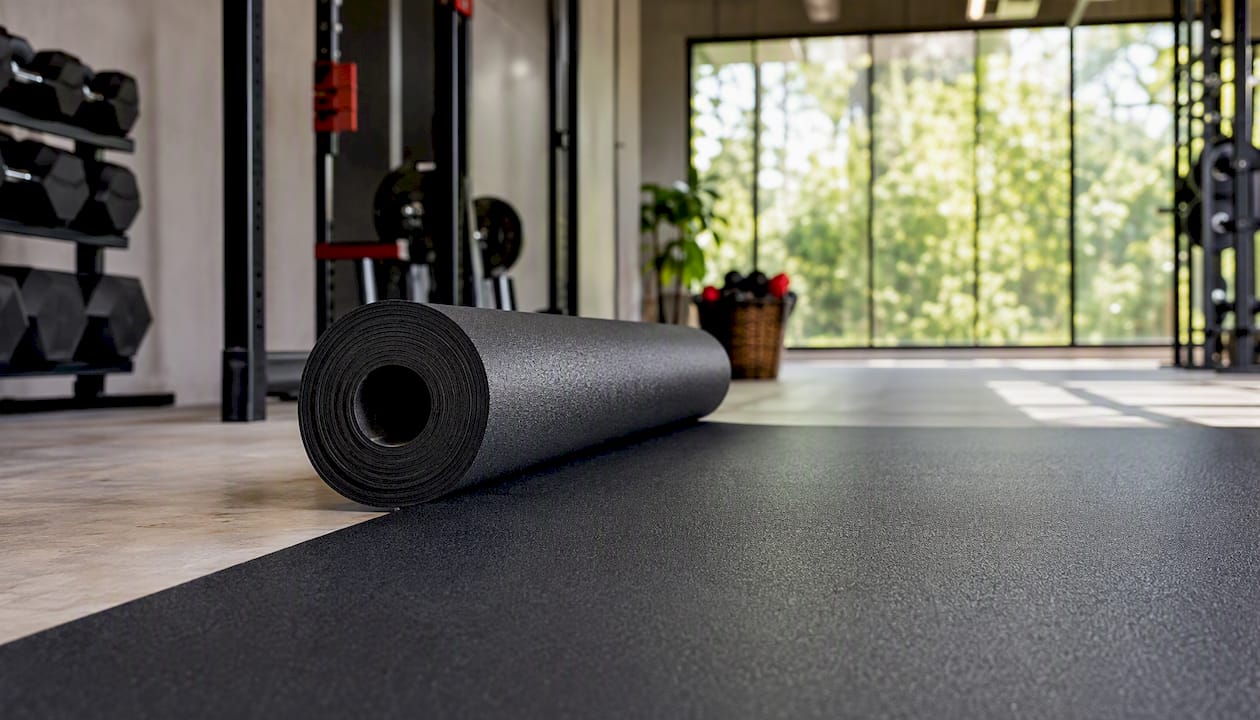
Rolls are the preferred choice for large continuous surfaces, such as corridors, extended cardio areas, or commercial gyms. They eliminate seams, ensure a uniform surface, and are installed with specific rubber adhesive. They require more installation time and are not easily removable, but they offer a clean aesthetic result and homogeneous subfloor protection.
A tip: don't just look at the price per square meter. Two tiles of the same thickness can have very different densities: the lighter one will cost less today, but will deform sooner.
How to choose the right flooring: technical criteria and warning signs
The choice of rubber gym flooring depends on five variables: intended use, thickness, density, certifications, and price per square meter. Evaluating them together, not separately, is what distinguishes a sound purchase from a disappointing one.
Practical checklist:
- Intended use: light home gym, weightlifting area, cardio area, CrossFit box, or commercial gym? Each context has different thickness and density requirements.
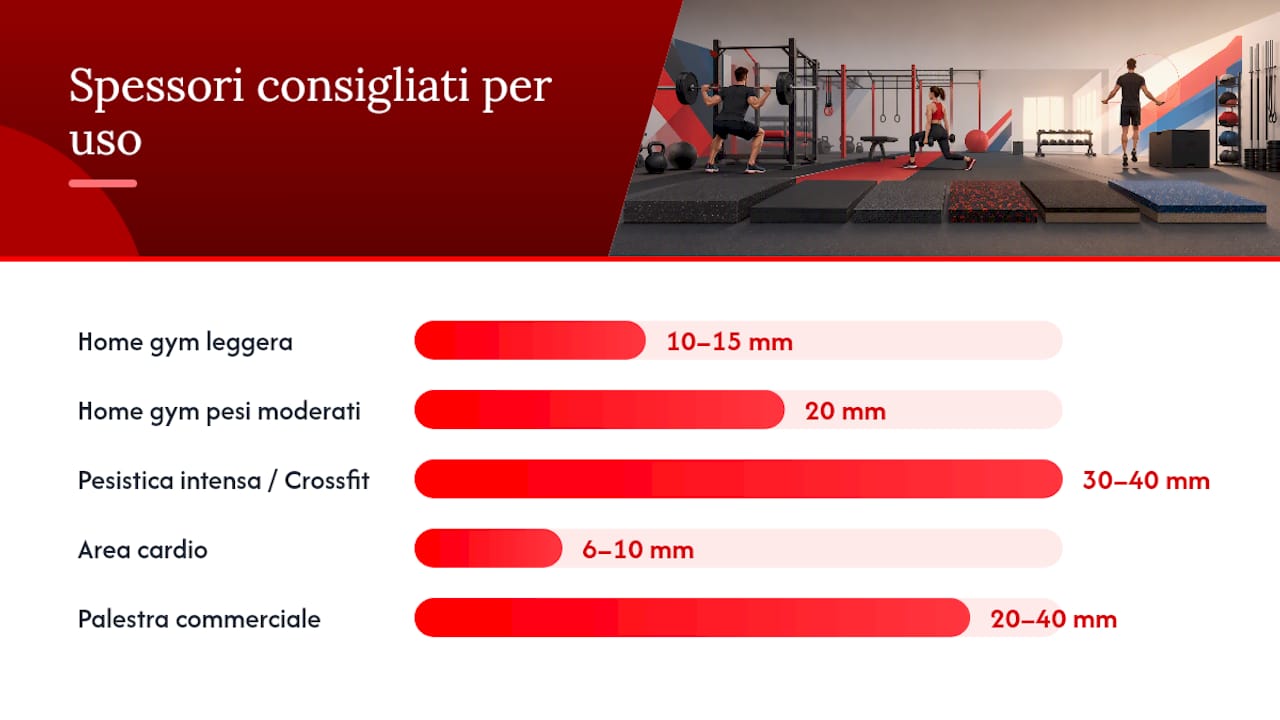
- Thickness: 10–15 mm for cardio and bodyweight; 20 mm for moderate weights; 30–40 mm for barbell drops and powerlifting.
- Density and durometer: ask for the Shore A value. A professional weightlifting tile has higher values than an EVA home gym mat.
- Shock absorption: check if the manufacturer provides test data or specific certifications for sports use.
- Non-slip: the surface finish must provide grip even with wet trainers.
- Odors and safety: a persistent chemical odor after 48–72 hours of aeration is a sign not to be ignored. Ask for the technical data sheet and REACH compliance declaration.
- Warranty: minimum 1–2 years for domestic products, 3–5 years for professional use.
Comparison by use, thickness, and material:
| Recommended use | Thickness | Material | Density/resistance | Shock absorption | Ease of installation | Indicative warranty |
|---|---|---|---|---|---|---|
| Light home gym (cardio, yoga) | 10–15 mm | EVA | Low-medium | Good | Very easy (interlocking) | 1 year |
| Home gym with moderate weights | 20 mm | EVA or SBR | Medium | Very good | Easy | 1–2 years |
| Intense weightlifting, CrossFit | 30–40 mm | SBR/EPDM | High | Excellent | Medium (optional adhesive) | 3–5 years |
| Cardio area (treadmill) | 6–10 mm | Rubber/EVA | Medium | Good + soundproofing | Easy | 1–2 years |
| Commercial gym | 20–40 mm | SBR/EPDM | High | Excellent | Requires professional | 5+ years |
Prices per square meter vary significantly depending on thickness and quality, with EVA puzzle mats generally less expensive than professional SBR/EPDM rubber tiles. Rubber rolls have prices similar to professional tiles, with additional installation costs.
Questions to ask the supplier before purchasing:
- Ask if the product complies with the REACH regulation and if a complete technical data sheet is available.
- Ask if the durometer value (Shore A) is documented and verifiable.
- Ask if the warranty covers permanent deformation and manufacturing defects.
- Ask if physical samples are available for testing before ordering.
Warning signs not to underestimate: absence of technical specifications in the product sheet, no written warranty, chemical odor that persists beyond 72 hours, undeclared density data. Professional customers should always request load tests to verify that the flooring does not deform with Olympic barbells.
Formats and dimensions: how many tiles do you need and how to calculate square meters
The most common formats on the market are four: 30x30 cm, 60x60 cm, 90x90 cm, and 100x100 cm. The choice of format affects installation time, the number of joints, and the ease of adaptation to irregular spaces.
- 30x30 cm: ideal for small spaces or irregular shapes; more joints, but maximum cutting flexibility.
- 60x60 cm: the most versatile format for home gyms; good balance between manageability and coverage. A set of several 60x60 cm tiles covers a typical home gym surface, an area around 9 m².
- 90x90 cm and 100x100 cm: reduce joints and speed up installation in large areas, but are harder to handle in tight spaces.
How to calculate how many tiles you need:
Measure the length and width of the area in meters, multiply to get the m², then divide by the surface area of a single tile.
Practical example: 4 m x 3 m room = 12 m². With 60x60 cm tiles (0.36 m² surface each): 12 ÷ 0.36 = 33.3 tiles.
For the layout, consider distinct functional zones: a central island for weights, a perimeter for cardio, and clear lanes for movement. Finished edges (elements with a ramp profile) are essential to prevent tripping and give a professional look to the installation. In irregular spaces, draw the perimeter with chalk before starting installation and plan cuts from the most visible corners.
How to install and maintain rubber gym mats?
The installation of modular rubber flooring is accessible even without experience, provided the steps are followed in the correct order. Hasty installation results in open joints and lifted surfaces.
- Subfloor preparation: the floor must be clean, dry, and free of irregularities greater than 3 mm. Remove dust, grease, and residue from old adhesives.
- Acclimation: leave the tiles in the environment for at least 24 hours before installation, especially in winter. Rubber expands with heat and contracts with cold.
- Interlocking installation: start from a corner and proceed in rows, ensuring each interlock is completely closed. Do not force the tiles: if they resist, check that the edge is clean.
- Edge cutting: use a sharp utility knife and a metal straightedge. For thicknesses over 20 mm, a band saw or jigsaw ensures more precise cuts.
- Optional fastening: for permanent installations or high-traffic areas, apply double-sided rubber tape or specific adhesive along the perimeter edges. Do not glue the entire surface if you want to maintain the possibility of removal.
Average installation times are around 30–45 minutes per 10 m² for interlocking tiles, excluding cuts.
Routine maintenance:
- Sweep or vacuum daily to remove dust and abrasive debris.
- Wash with lukewarm water and a neutral detergent (pH 6–8) once a week.
- Avoid solvents, bleach, acids, and metal brushes: they degrade the rubber and reduce its useful life.
- For stubborn stains (grease, resin), use a cloth with diluted isopropyl alcohol, then rinse thoroughly.
A tip: check the joints every 2–3 months. If you notice openings or lifting, reposition the tiles and check that the subfloor has not settled. An open joint is not just an aesthetic problem: it is a real tripping hazard.
Also periodically check the surface for localized deformations, especially in areas where equipment feet rest. A hard rubber disk under the feet of machinery better distributes the load and extends the life of the flooring.
Materials, safety, and certifications: what to check before buying
The safety of gym flooring is not measured solely by its non-slip properties.
Main materials:
- EVA: lightweight, flexible foam, good elasticity and shock absorption. Suitable for domestic use; less wear-resistant than rubber.
- SBR: recycled rubber from tires, high density and mechanical resistance. The standard material for professional gyms.
- EPDM: synthetic rubber with excellent resistance to weathering, UV rays, and moisture. Often used as a surface layer in SBR/EPDM tiles.
- Nitrile: rubber with high resistance to oils and solvents; suitable for garages and workshops, less common in gyms.
Certifications and declarations to request:
- Compliance with the REACH regulation: guarantees the absence of hazardous chemical substances beyond the thresholds permitted by European regulations.
- Absence of phthalates and BPA: explicit declaration from the manufacturer, not just a generic "non-toxic" label.
- Density and durometer data (Shore A): numerical values, not generic descriptions like "high density."
- Shock absorption tests: useful for areas with dropped weights; some manufacturers provide specific certifications for sports use.
- Safety Data Sheet (SDS): technical document describing composition, risks, and disposal procedures.
Initial odors are normal, especially for SBR rubber: they result from volatile compounds (VOCs) released in the first hours after opening the packaging. Ventilate the environment for 24–72 hours before using the space. If the odor persists beyond 72 hours with adequate ventilation, ask the supplier for the VOC technical sheet and consider returning the product.
A tip: always prefer products with a complete technical data sheet and written warranty. A supplier who does not provide these documents upon request does not deserve your trust, regardless of the price.
Teknofitness solutions and services: catalog, installation, and assistance
Teknofitness offers concrete solutions for those who want to set up a home gym or equip a professional gym with reliable and certified flooring. Among the available products, the Toorx 6 mm professional soundproofing mat is designed to protect the floor under treadmills, exercise bikes, and cardio equipment, reducing vibrations and noise transmitted to the subfloor. It is the ideal solution for those with a home gym in an apartment or shared space.
For areas with heavier equipment, such as squat racks or Olympic barbells, Teknofitness recommends thicker tiles, combined with personalized advice to identify the most suitable product for the actual load.
Available services include personalized quotes, paid installation, and after-sales technical support. To request a quick quote, it is helpful to prepare: a floor plan of the area (even a photo with hand-written measurements), the intended use (home gym, box, commercial gym), and a list of existing or planned equipment. These details allow for a precise proposal, with suggested products, installation options, and delivery times.
The perspective of someone who has seen many installations
Anyone who has worked in the sector for years knows that the most common mistake is not choosing the wrong material: it's underestimating the thickness in the weights area. A 10mm mat under a 100kg barbell protects neither the floor nor the tiles themselves. The deformation is progressive and often invisible until the weight is removed.
For those who are undecided, the practical advice is to start with an island of 4-6 tiles of 30-40mm under the weightlifting area, and complete the rest of the space with 15-20mm EVA. This approach balances cost, performance, and durability without oversizing the entire floor. Modularity is the real advantage of puzzle systems: you can add, replace, or reconfigure zones as your gym grows.
Request a quote from Teknofitness: what to prepare and how to proceed
Teknofitness is the go-to for anyone who wants gym flooring that lasts, with the support of someone who truly knows the industry. Not a call center, not an algorithm: a person who answers, assesses your space, and proposes the right solution.
To receive a personalized quote, follow these steps: measure the area in meters (length x width), take a photo of the current space, note the existing or planned equipment, and indicate the intended use (home gym, box, commercial gym). With this information, Teknofitness can propose specific products, installation options, delivery times, and included warranty.
The quote also includes a buying guide for correctly matching flooring and equipment. Visit Teknofitness to request direct assistance or consult the complete catalog.
Sources
A tip: always use the original manufacturer's technical data sheets to verify thickness, density, and certifications before finalizing your purchase. The data declared on packaging or in online descriptions does not always correspond to the actual product specifications.